Practical guides, fresh perspectives, and remarkable stories from the world of money. Explore personal finance, business, property, and the lifestyles wealth makes possible.
From deep-blue boron diamonds and vivid crimson musgravites to celestial jadeites, explore the 10 rarest and most expensive gemstones in the world, ranked from $10,000 to over $3.9 million per carat.
Building real wealth is rarely about how much you earn—it is decided by how ruthlessly you plug the invisible leaks in your balance sheet. In a consumer economy designed to siphon your capital through high-pressure coaching funnels, deceptive subscriptions, and the devastating 'house-poor' trap, hundreds of thousands of dollars evaporate before they ever have the chance to compound. Eliminating just a handful of these hidden drains can easily recover $500 to $1,500 every single month—capital that blossoms into over $750,000 when redirected into productive investments. Here are the 15 most toxic money traps draining your net worth right now, and the exact mathematical alternatives to deploy instead.
Crossing the seven-figure milestone changes the rules of personal finance overnight: the challenge is no longer just making money, but defending it against inflation, tax drag, and catastrophic missteps. Left uninvested in a conventional bank account, a $1,000,000 cash reserve loses more than $30,000 in purchasing power every single year. Deploying institutional-grade capital demands moving beyond basic retail advice and engineering a resilient, cash-flowing wealth architecture. From turnkey small business acquisitions and multi-family real estate to recession-proof dividend aristocrats and index engines, here are 17 high-impact ways to deploy $1 million to generate predictable yield and secure multi-generational freedom.
Imagine keeping 100% of your salary, consulting income, and investment gains every single month without forfeiting a single dime to personal income tax. While high-earners across Europe and North America surrender between 40% and 58% of their gross earnings to state treasuries, an elite group of sovereign nations operates with an absolute 0% personal income tax rate. But living tax-free is not magic—every country has to pay its bills somehow, whether through natural resource wealth, steep import tariffs, or luxury consumption duties. From the superyacht harbors of Monaco and Dubai to Caribbean offshore enclaves, here are the top 9 verified zero-income-tax countries in 2027, the realistic residency pathways to enter them, and the hidden cost trade-offs you must know before packing your bags.
Ten commercial institutions quietly control over $41 trillion in capital—more than double the entire annual economic output of the United States. Behind their glass skyscrapers and polished marble lobbies, these mega-lenders underwrite sovereign debts, finance global energy grids, and dictate the flow of international trade. While Wall Street commands unprecedented market valuations, a dramatic geopolitical shift over the past decade has handed the balance-sheet crown to Beijing's state-owned giants. From European banking dynasties to Manhattan trading floors and Asia's trillion-dollar credit machines, here is the definitive countdown of the world's 10 richest banks, ranked from lowest to highest by total assets.
Most people are conditioned to believe that getting rich is simply a matter of earning a decent income and having a little cash left over when the month wraps up. But having unspent cash in a basic checking account is not building wealth—it is merely financial survival. Real wealth is not determined by how much you earn, what car you drive, or how flashily you dress; it is governed entirely by how effectively you convert income into productive, cash-flowing assets that compound independently of your physical labor. Whether you earn an entry-level wage or command a high-six-figure salary, failing to understand the core mechanics of money leaves you vulnerable to inflation, predatory banking fees, devastating lifestyle creep, and excessive taxation. From decoding bank fee fine print and basis point margins to mastering productive leverage, uncorrelated diversification, and automated compounding, here are the 19 foundational money skills everyone must master to build and protect lasting financial freedom.
Too many personal finance conversations focus exclusively on deprivation: cut your streaming plans, cancel your dining, and eliminate every expenditure that brings joy. But building real wealth is not about hoarding pennies in a vacuum; it is about allocating capital with ruthless intentionality. While reckless lifestyle inflation will destroy your balance sheet, extreme cheapskating often costs far more in the long run through chronic health issues, structural repairs, professional stagnation, and ruined experiences. The world's most effective wealth builders do not avoid spending money—they invest aggressively in high-ROI physical assets, preventative health safeguards, career amplifiers, and irreplaceable milestone memories that pay compounding dividends for decades. Here are the 15 essential things you should unashamedly spend your money on, and why every dollar deployed into them pays you back tenfold.
Discover how billionaires and ultra-wealthy dynasties structure revocable and irrevocable trust funds to shield assets from probate, optimize estate taxes, and protect generational wealth across decades.
Over 82% of small businesses and independent freelancers rely on AI tools, yet most operators still struggle to determine which applications deliver tangible ROI versus expensive novelty. From autonomous desktop agents and real-time meeting intelligence to 24/7 AI customer service chatbots, here is the definitive guide to the top AI tools every small business and freelancer should use in 2027 to eliminate admin burnout and accelerate growth.
While both gross margin and profit margin measure business profitability as a percentage of revenue, they tell completely different financial stories. Confusing the two can lead to flawed pricing decisions and misleading cash flow expectations. Here is an executive breakdown of the differences, exact calculation formulas, income statement mechanics, and real-world corporate examples.
Revenue is a vanity metric; net profit is your company's true financial reality. Discover the step-by-step formula to calculate net profit, separate production costs from operating overhead, and analyze real business scenarios with precision.
While industry surveys claim restaurants must survive on razor-thin 3% to 5% margins, top-tier independent operators regularly achieve 15% to 20% net profit. Learn the real benchmarks by restaurant concept, master the new 55% prime cost rule, and discover the operational systems required to turn high sales into real bottom-line cash.
In manufacturing, profit margins are shaped by heavy capital expenditures, fluctuating raw material indices, and direct factory labor. While general industrial averages range between 5% and 10%, top-tier precision and automated producers achieve 15%+. Discover benchmarks across manufacturing sub-sectors and the operational levers that drive true plant profitability.
Gross profit margin is the economic engine that funds operations, salaries, and owner profits. When gross margins are thin, every sales dollar feels exhausting. Explore 10 proven, actionable strategies—including the 7 core operational levers plus 3 advanced CFO tactics—to lift your gross margins and capture more profit on every transaction.
In a company generating $1,000,000 in annual revenue, improving your operating margin by just a single percentage point puts an extra $10,000 directly onto your bottom line. Yet countless business owners obsess over top-line sales while thousands of dollars silently drain out through hidden operational cracks. Increasing sales is rarely the fastest path to increasing profit—often, the cash you need is already inside your business, waiting to be recovered.
A company can generate tens of millions in annual revenue and still face immediate insolvency if its gross profit margin is dangerously weak. Gross profit margin is the foundational financial efficiency ratio that measures how much money remains from each sales dollar after subtracting the direct costs of goods sold (COGS). It answers the most fundamental business question: after making or purchasing what we sell, does our basic economic engine actually work?
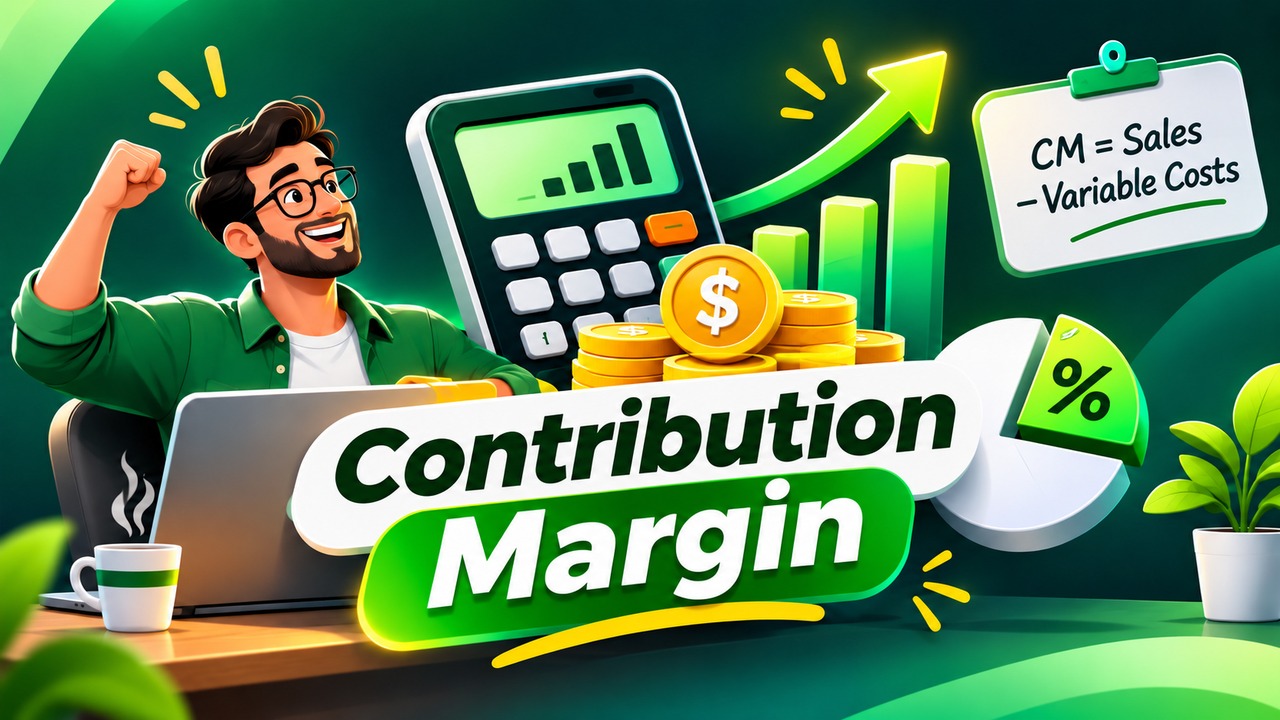
Before launching a new manufacturing plant, product line, or commercial venture, every entrepreneur confronts a decisive question: how many units must we sell to stop losing money and begin generating real profit? Contribution margin provides the mathematical answer. By stripping away fixed facility costs and isolating direct variable expenses, contribution margin reveals exactly how much cash each incremental transaction contributes toward covering fixed overhead and generating operating income.
Homes currently linger on the market for an average of 63 days, leaving sellers trapped in mounting holding costs, mortgage interest, and stressful uncertainty. Whether you are relocating for a career move, liquidating an inherited property, or downsizing quickly, here is the proven playbook to sell your house fast on the open market—plus the real financial math behind 7-day cash offers.
A modern supermarket can sell everyday essentials like milk, eggs, and bread at razor-thin margins or outright losses and still generate billions in enterprise revenue. With average food retail net profit margins hovering at just 1% to 2%, here is the hidden business model supermarkets use to turn volume, aisle psychology, trade spend, and customer baskets into massive corporate profits.
Before expanding payroll into bloated overhead, discover the essential five-person startup architecture that allowed modern disruptors to outmaneuver entrenched industry giants, protect cash runway, and engineer sustainable, scalable profitability.
Discover verified median net worth, low thresholds, and top 10% wealth benchmarks across every age bracket, helping you benchmark your financial progress from your first paycheck into retirement.
Viral videos across TikTok, X, and YouTube claim that a nationwide electrical and banking blackout will hit the United States on November 17. The rumors have sparked widespread anxiety about frozen ATMs, disrupted credit card networks, and whether families should rush to withdraw physical cash. Here is the verified reality behind the scheduled FEMA emergency test, the technological architecture that keeps American banks operational, and the exact mathematical formula for how much cash you should realistically keep at home without losing thousands to the "mattress tax."
Here is a fundamental question for every independent worker: when a client pays you, where does that money land? If the answer is your personal checking account, you are making tax time, expense tracking, and long-term budgeting significantly harder than they need to be. According to economic data from MBO Partners, a record 74.9 million Americans earn independent income. In IRS Publication 583 ("Starting a Business and Keeping Records"), the tax authority strongly advises opening a dedicated business checking account to clearly segregate personal and commercial transactions. Today, modern financial technology has eliminated monthly maintenance fees, minimum balance requirements, and tedious paperwork. In this authoritative 2027 guide, we rank the top 5 business bank accounts designed specifically for freelancers, evaluating fees, tax automation tools, checking interest rates, and underlying FDIC deposit safety.
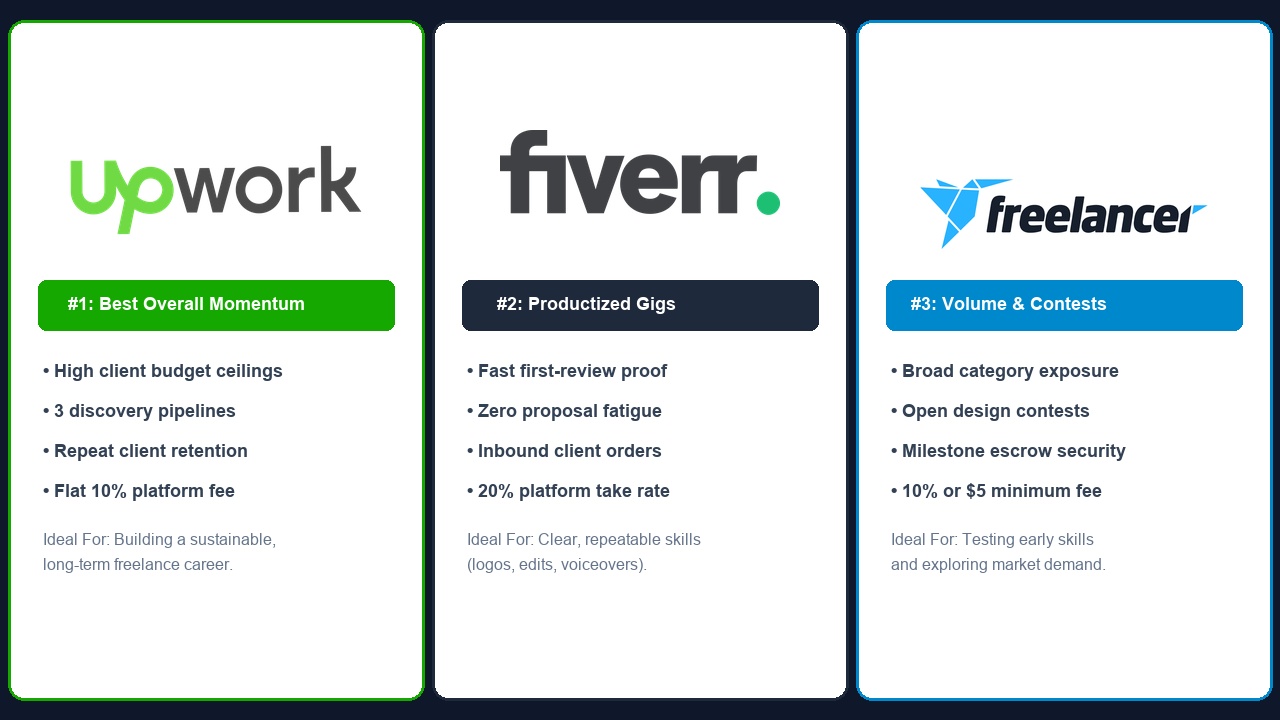
Most beginners mistakenly believe the best freelance website is simply the one with the highest sheer volume of job listings. That intuition sounds logical, but in practice, it almost always leads to the exact same painful trap: overwhelming global competition, weak personal positioning, proposal burnout, and no clear roadmap to earning that critical first paid review that convinces skeptical clients to trust you. The smarter question is not where the most jobs exist—it is where an unvetted beginner can actually get noticed without being invisible. The platform you choose does not just dictate where you look for work; it fundamentally shapes how you are forced to sell yourself. In this comprehensive 2027 guide, we break down the three premier beginner-friendly freelance marketplaces—Freelancer.com, Fiverr, and Upwork—analyzing client discovery pipelines, take-rate economics, escrow security, and how to choose the right training ground for your specific freelance skillset.